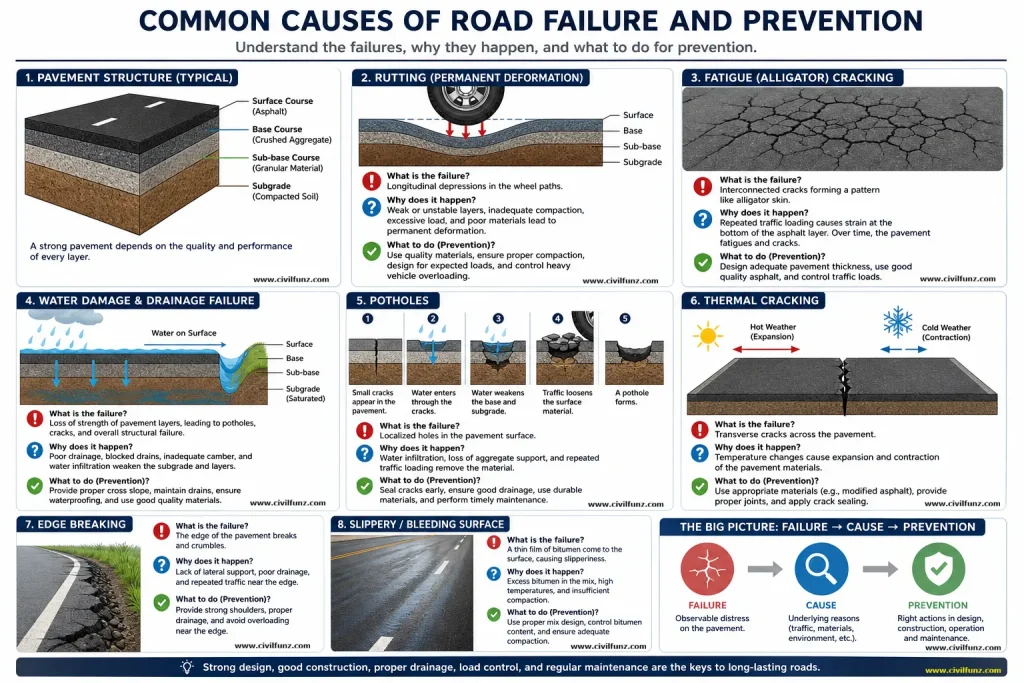
Roads are essential for economic growth, transportation, and regional connectivity. However, many roads deteriorate long before their intended design life due to problems such as rutting, cracking, potholes, and surface deformation. These failures not only increase maintenance costs but also reduce safety and driving comfort.
Most road failures are caused by a combination of poor drainage, overloading, weak construction practices, inadequate design, and insufficient maintenance. Understanding the root causes behind these problems is important for developing durable and cost-effective road infrastructure. This article explains common types of road failures in a practical format:
Failure → Why it happens → How to prevent it.
By connecting each failure with its causes and preventive measures, the article highlights how proper design, quality construction, and timely maintenance can significantly improve pavement performance and lifespan.
Contents
1. Rutting (Wheel Path Deformation)
1.1 What is the failure?
Longitudinal depressions formed in the wheel paths due to permanent deformation of pavement layers under repeated traffic loading.
1.2 Why does it happen?
• Weak subgrade or base layers
• Excessive axle loads (overloading)
• Poor compaction during construction
• High temperatures softening asphalt
1.3 How to prevent it?
• Improve subgrade strength through stabilization where necessary
• Ensure proper compaction of all pavement layers
• Design pavement for realistic traffic loading (ESAL)
• Use stable asphalt mixes and modified bitumen in hot climates
• Strengthen base and sub-base layers where required
2. Fatigue Cracking (Alligator Cracks)
2.1 What is the failure?
Interconnected cracks resembling alligator skin, typically occurring in wheel paths due to repeated pavement fatigue.
2.2 Why does it happen?
• Repeated traffic loading beyond pavement design capacity
• Inadequate pavement thickness
• Weak base, sub-base, or subgrade layers
• Aging and loss of asphalt flexibility
• Poor drainage leading to moisture weakening
2.3 How to prevent it?
• Design adequate pavement thickness for expected traffic loads
• Strengthen base and sub-base layers
• Control excessive axle loads
• Ensure proper drainage to prevent moisture damage
• Perform timely overlays and preventive maintenance before cracking spreads
3. Potholes
3.1 What is the failure?
Localized depressions or holes formed due to the disintegration of pavement surface layers.
3.2 Why does it happen?
• Water infiltration through cracks and surface defects
• Weak bonding or stripping between asphalt layers
• Repeated traffic loading on weakened pavement
• Poor drainage and moisture damage
• Delayed or inadequate maintenance
3.3 How to prevent it?
• Seal cracks and surface defects early
• Ensure effective surface and subsurface drainage
• Use quality materials and proper compaction
• Conduct routine maintenance and timely patch repairs
• Repair damaged areas before deterioration spreads
4. Longitudinal and Transverse Cracking
4.1 What is the failure?
Cracks that develop parallel (longitudinal) or perpendicular (transverse) to the road centerline.
4.2 Why does it happen?
• Temperature variations causing thermal stress
• Shrinkage and aging of asphalt
• Poor construction joints or lane joints
• Reflective cracking from underlying pavement layers
• Differential settlement or weak pavement support
4.3 How to prevent it?
• Use temperature-resistant and properly designed asphalt mixes
• Ensure proper joint construction and compaction
• Improve pavement structural support
• Apply crack sealing and preventive maintenance early
• Use overlay treatments or stress-relief layers where necessary
5. Edge Failure
5.1 What is the failure?
Cracking, breaking, or deterioration occurring along the edges of the pavement surface.
5.2 Why does it happen?
• Lack of adequate shoulder support
• Poor drainage and water infiltration near pavement edges
• Traffic loads moving too close to the pavement edge
• Weak or eroded edge support materials
• Inadequate pavement width for traffic conditions
5.3 How to prevent it?
• Provide properly compacted and stable shoulders
• Improve edge drainage and prevent water accumulation
• Strengthen pavement edges where necessary
• Maintain shoulder levels to support the pavement edge
• Restrict heavy vehicles from operating too close to edges where possible
6. Bleeding (Flushing)
6.1 What is the failure?
Excess asphalt binder rises to the pavement surface, creating a shiny, smooth, and sometimes sticky layer.
6.2 Why does it happen?
• Excess asphalt binder in the mix
• Low air voids due to over-compaction
• High temperatures softening the binder
• Heavy traffic loading causing binder migration
6.3 How to prevent it?
• Use proper asphalt mix design and correct binder content
• Maintain adequate air voids during compaction
• Avoid excessive compaction during construction
• Use suitable binder grades for climatic conditions
• Apply proper construction quality control
7. Corrugation and Shoving
7.1 What is the failure?
Wave-like distortions or localized bulging of the pavement surface caused by plastic movement of asphalt layers
7.2 Why does it happen?
• Unstable or weak asphalt mix
• Poor bonding between pavement layers
• Inadequate compaction during construction
• Repeated braking and acceleration forces
• Excessive moisture or weak underlying layers
7.3 How to prevent it?
• Use stable and properly designed asphalt mixes
• Ensure proper layer bonding using tack coat
• Achieve adequate compaction during construction
• Improve quality control during paving operations
• Strengthen weak base or subgrade layers where necessary
8. Surface Erosion and Ravelling
8.1 What is the failure?
Gradual disintegration of the pavement surface due to the loss of aggregates from the asphalt layer
8.2 Why does it happen?
• Poor quality or weak aggregates
• Insufficient asphalt binder in the mix
• Weathering and traffic wear
• Poor compaction during construction
• Continuous traffic wear and environmental exposure
8.3 How to prevent it?
• Use durable and properly graded aggregates
• Ensure proper asphalt mix design and binder content
• Achieve adequate compaction during construction
• Apply preventive surface treatments such as seal coats
• Perform timely maintenance before surface deterioration progresses
Road failures should not be treated as isolated problems because each type of failure reflects deeper issues in design, materials, construction, or maintenance. A systematic approach that identifies the failure, analyzes its causes, and applies appropriate preventive measures leads to more durable and cost effective road infrastructure.
For a broader discussion on sustainable road performance, proper material selection, drainage systems, and environmentally responsible construction practices, read our related article: “Ensuring Longevity: Materials, Drainage, and Environmental Compliance in Road Construction.”