Have you ever wondered about Cable-Stayed and Suspension Bridges? Today, let’s talk about their key differences. The choice between cable-stayed and suspension bridges is often influenced by engineering considerations related to the span length, including the required strength, flexibility, and stability of the bridge structure. Before reading the whole article, go through the Contents section and jump to the specific item you want to read. It could save you time! Happy reading!!!
Contents
Cable-Stayed and Suspension Bridge
Before going deep into the differences, have a glimpse of what a Cable-Stayed Bridge and a Suspension Bridge are.
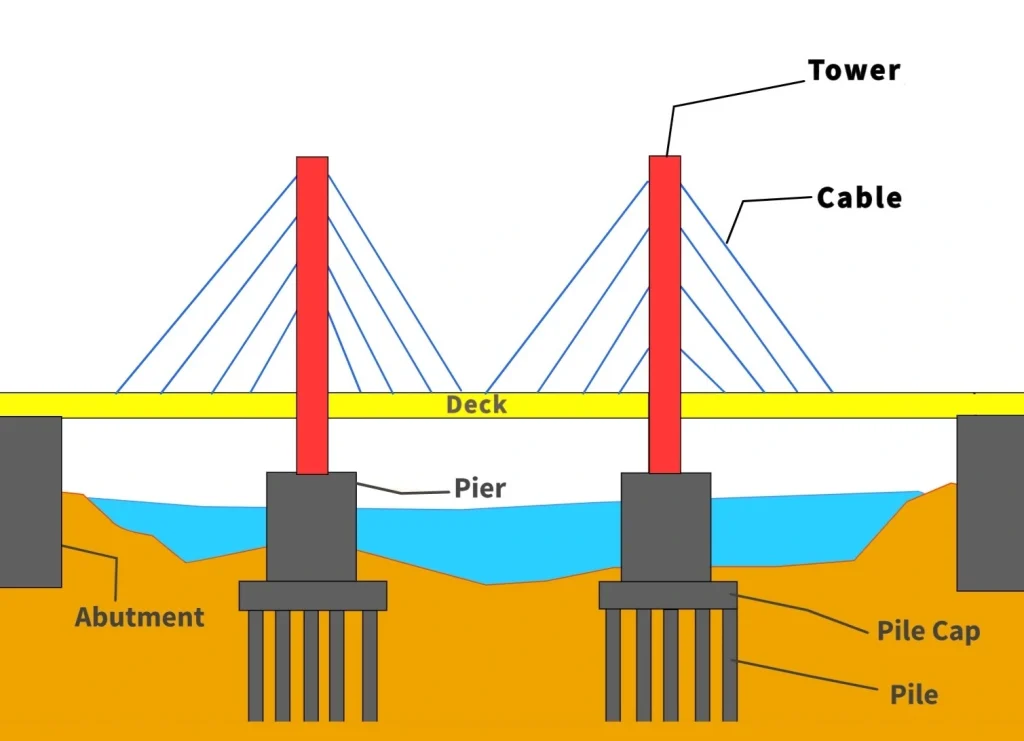
A Cable-Stayed Bridge is a type of bridge where the deck is supported by number of nearly straight diagonal cables attached to towers
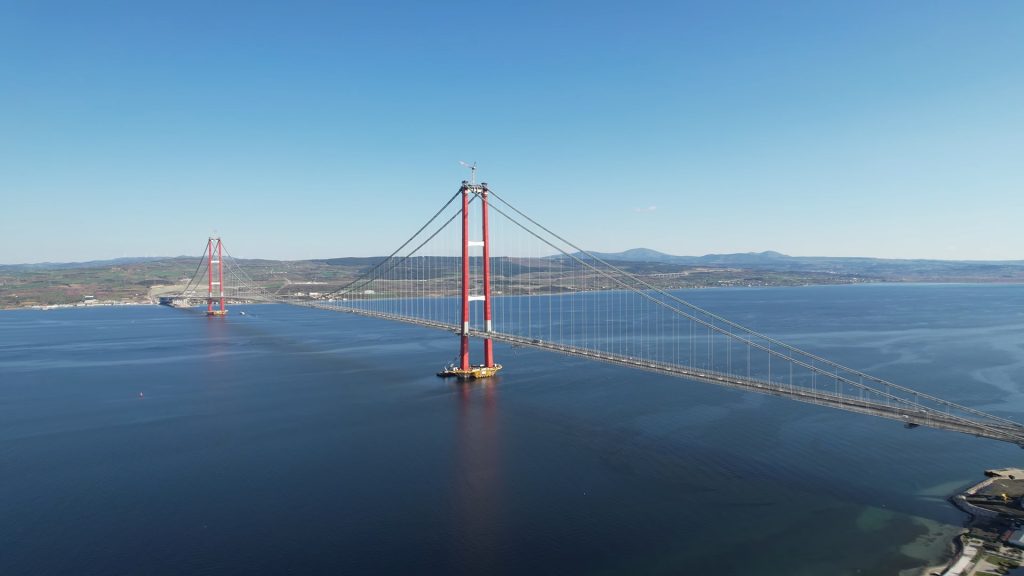
A Suspension Bridge is a type of bridge where the deck is suspended from vertical cables that hang from two or more towers

In a suspension bridge, the main cable tension is concentrated in the anchorages at each end. By contrast, the cable tension in a cable-stayed bridge is distributed over many anchorages along the deck.
Key Differences between Cable-Stayed Bridge and Suspension Bridge:
We will discuss the differences between the cable-stayed and suspension bridges in two different aspects. One is from the Technical aspects, and the other is from the Non-Technical aspects.
A. Technical Difference
A.1. Cable Arrangement
In a Cable-Stayed Bridge, the cables are connected directly between the towers and the bridge deck.
In a Suspension Bridge, the cables pass over the towers and are anchored on either side, with hangers connecting the cables to the bridge deck.
A.2. Cable Configuration
In a Cable-Stayed Bridge, the cables are typically arranged in a radial pattern, spreading out from the tower to support the bridge deck. The cables are often attached to the tower at different heights.
In a Suspension Bridge, the main cables are parallel and run the entire length of the bridge. Vertical suspenders/cables connect the main cables to the bridge deck at regular intervals.
A.3. Arrangement of Towers
In Cable-Stayed Bridge, the towers are directly connected to the bridge deck, and the cables extend from the towers to support the deck.
In Suspension Bridges, the towers are not directly connected to the deck; instead, the main cables pass over the towers and are anchored to the ground, and the deck is suspended from these cables.
A.4. Tower Configuration
The towers in Cable-Stayed Bridges are positioned at various points along the span of the bridge, and the cables radiate from these towers to support the bridge deck.
In contrast, the main cables in a Suspension Bridge pass over the tops of the towers and are anchored on solid ground on either side of the bridge.
A.5. Tower Height
Towers in Cable-Stayed Bridges are generally shorter since they provide vertical support for the cables. In comparison, towers in Suspension Bridges are taller to accommodate the passage of the main cables over their tops, and they also need to provide sufficient clearance for navigation underneath.
In short, the towers in suspension bridges are taller and fewer in number compared to cable-stayed bridges, as they primarily serve to anchor and support the main cables.
A.6. Span Length
Cable-Stayed Bridges become more cost-effective for medium to long spans. The span length of cable-stayed bridges is generally considered suitable for spans ranging from around 200 meters (656 feet) to over 1,000 meters (3,280 feet).
Suspension Bridges are particularly well-suited for very long spans. Suspension bridges can efficiently cover spans ranging from approximately 300 meters (984 feet) to several kilometers. Some of the longest bridges in the world are suspension bridges, such as the 1915 Çanakkale Bridge in Turkey, with a main span of 2,023 meters (~6,637 feet).
A.7. Stiffness and Vibrations
Cable-stayed bridges are often stiffer than suspension bridges.
The direct connection of cables to the deck and towers can reduce the susceptibility to lateral movements and vibrations in a Cable-Stayed bridge. Meanwhile, with their longer main cables and hanging deck, Suspension Bridges exhibit more flexibility and susceptibility to lateral movements and wind-induced vibrations.
A.8. Deck Support
In a cable-stayed bridge, all the loads (Dead and Live) subjected upon the deck are directly supported by the cables. The load is transferred from the deck to the towers through these cables.
In a suspension bridge, the deck is suspended from the main cables, and the load is transferred from the deck to the main cables through vertical suspenders.
A.9. Wind Resistance
Due to their longer spans and flexible hanging deck, Suspension Bridge may experience more movement in response to wind, requiring additional engineering considerations for stability. On the other hand, the direct connection between the cables and the deck in a Cable-Stayed bridge can reduce the impact of lateral forces. Hence, Cable-stayed bridges tend to have better resistance to wind loads due to their stiffer configuration.
B. Other Non-Technical Difference
B.1. Application
Cable-stayed bridges are commonly used for medium to long spans and are well-suited for locations with challenging navigational clearances.
In contrast, Suspension bridges are often chosen for very long spans, such as those crossing large bodies of water, where their inherent ability to cover longer distances without the need for additional supports is advantageous.
B.2. Construction Time
Cable-stayed bridges often have shorter construction times compared to suspension bridges. The modular construction of the deck and the more straightforward cable arrangement contribute to a faster overall construction process.
B.3. Construction Complexity
The construction process for Cable-Stayed bridges is often more straightforward than that of suspension bridges. The deck is usually constructed segmentally, and the cables are attached as construction progresses. However, Suspension bridges may require temporary support structures or floating platforms during construction, making the process more complex, especially for longer spans.
B.4. Maintenance
Maintenance of cable-stayed bridges is often simple compared to suspension bridges.
The cables in Cable-Stayed bridges are usually more accessible for inspection and maintenance. They generally have easier access for maintenance due to the arrangement of cables, which are more straightforward to inspect and repair.
On the other hand, maintenance of the main cables and vertical suspenders may require more specialized equipment and expertise in a Suspension Bridge.
B.5. Cost
Generally, Cable-Stayed bridges are considered more cost-effective for medium spans, while Suspension bridges become more economical for longer spans. The choice depends on the specific project requirements and budget constraints.
B.6. Construction Materials
Cable-stayed bridges often use a combination of steel and concrete for their construction. The towers are commonly made of reinforced concrete, while the cables are made of high-strength steel.
Suspension bridges also use steel and concrete but require larger quantities of steel for the main cables. The towers can be made of steel or concrete.
B.7. Visual Appearance
Cable-stayed bridges often have a more futuristic and geometric appearance, with towers rising directly from the deck and cables arranged in a fan-like or harp-like pattern.
Meanwhile, Suspension bridges are often considered more aesthetically pleasing and iconic with their graceful curves and long, sweeping cables.
B.8. History
Cable-stayed bridges have been more commonly constructed in the latter half of the 20th century and into the 21st century.
Suspension bridges, such as the Golden Gate Bridge and the Brooklyn Bridge, have a longer history and were often built in the early to mid-20th century.
In conclusion, cable-stayed and suspension bridges are distinct structural marvels with variations in their technical and non-technical aspects. The choice between cable-stayed and suspension bridges depends on the project’s unique requirements, considering factors ranging from technical specifications to budget constraints and aesthetic considerations. Both bridge types show the evolution of engineering ingenuity, offering solutions tailored to the diverse challenges presented by infrastructure projects worldwide.
Keep Reading: Discover More Insights
Recent Posts
- Common Road Failures Explained: Causes, Prevention, and Engineering Solutions
- Methods, Best Practices, and Minimum Curing Requirements of Concrete Structures
- How to Check Brick and Brick Chips Quality on Site
- How to Calculate Bitumen Percentage in Hot Mix Asphalt: Methods Explained
- Gradation Curves: Importance in Construction and Step-by-Step Guide with Real-World Examples