Greetings, Bridge Enthusiasts!
Today, we’re embarking on a straightforward journey into the world of suspension bridges. In this article, we’ll explore the key members that give suspension bridges their distinctive look. We’ll break down the nitty-gritty, ensuring you understand how every component contributes to the bridge’s strength. Think towering towers, strong cables, and the road beneath your feet – each with a unique role to play.
Finally, we’ll answer a common question: How does a suspension bridge handle all that weight? We’ll trace the journey from the bridge to the ground, exploring the ingenious ways it manages to take heavy loads.
So, whether you’re a bridge buff or just someone curious about how these giants work, join us for a laid-back tour through the basics of suspension bridges. It’s all about uncovering the secrets behind their design and appreciating the genius.
Before reading the whole post regarding the suspension bridge, we recommend you go through the Contents section and jump to the specific content you want to read. It could save you time! Happy reading!!!
Contents
What is a Suspension Bridge?
A suspension bridge is where the deck (the roadway or pedestrian pathway) is suspended from cables anchored to vertical towers.
Suspension bridges are known for their ability to span long distances, making them suitable for crossing large bodies of water or deep valleys. The design of a suspension bridge allows more flexibility and durability, making suspension bridges a popular choice for various engineering applications. (Advantages of Suspension Bridges)
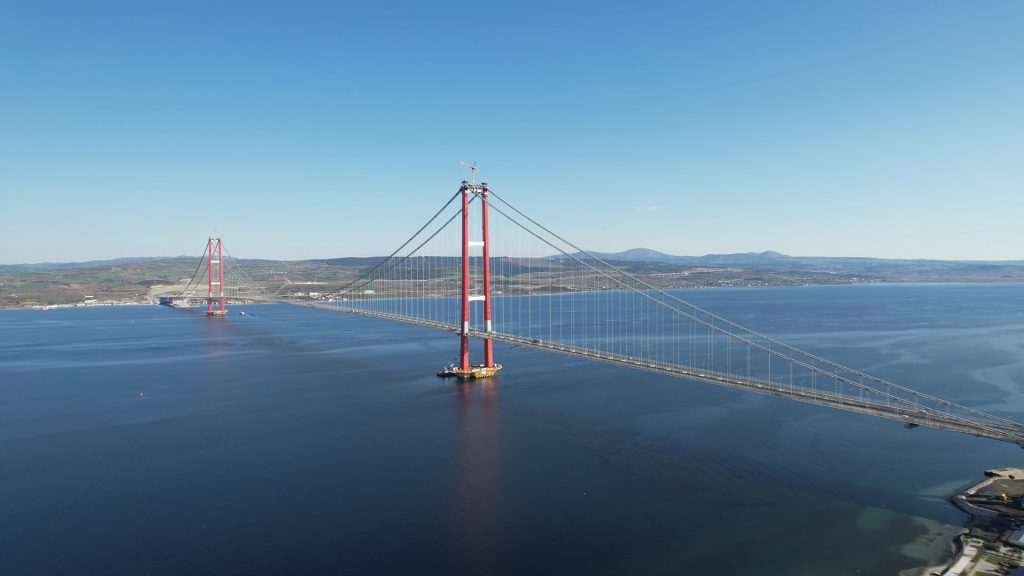
Iconic examples of suspension bridges include the Golden Gate Bridge in San Francisco, the Akashi Kaikyō Bridge in Japan, and the Brooklyn Bridge in New York City. Last but not least, The 1915 Çanakkale Bridge, the Longest Suspension Bridge, is truly an inspiration for modern structures!
It is to be noted that in a suspension bridge, the main cable tension is concentrated in the anchorages at each end. By contrast, the cable tension in a cable-stayed bridge is distributed over many anchorages along the deck.
Key Members of a Typical Suspension Bridge and Their Functions:
Like all other bridges, Suspension bridges have foundations, girders, decks, abutments, etc. Still, the main difference from other bridges is that it must include the main parabolic-shaped cables, suspenders, towers, and anchorages.
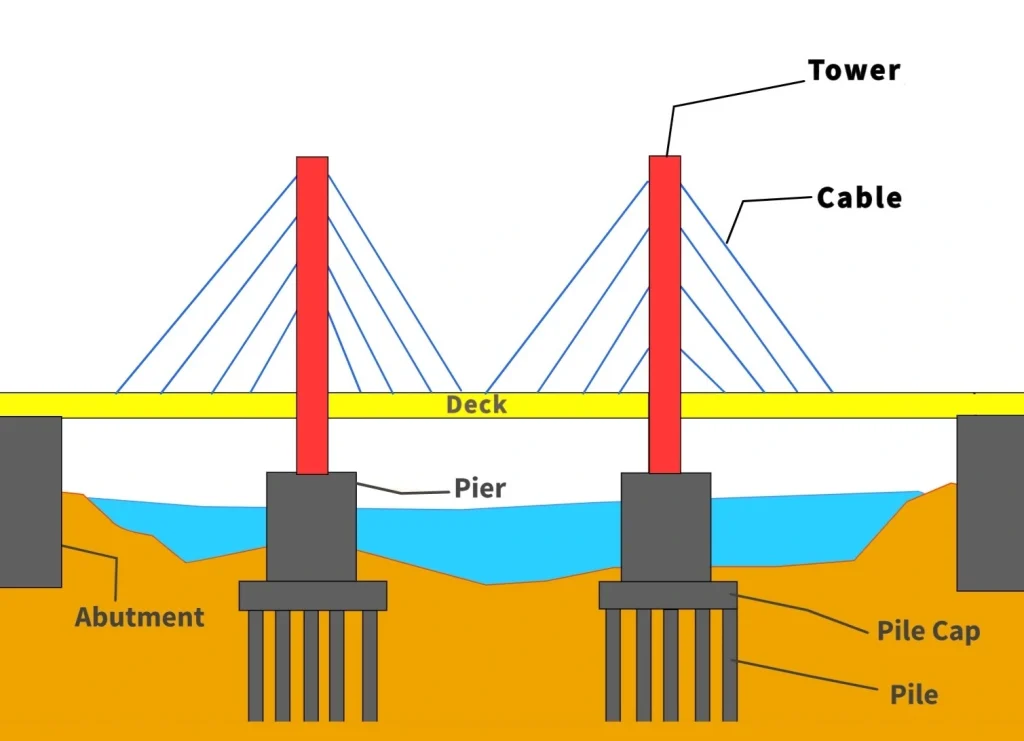
The following figure describes the key components of a typical suspension bridge.

1. Deck:
The part of the bridge which carries the traffic, pedestrians, or other loads is called the deck. It hangs from vertical cables and is often a flexible structure. The deck is the main area of the bridge where vehicles and people travel.
2. Cables:
Parabolic-shaped main supporting cables take the dead & live load of the bridge deck slab from the suspenders and transfer it to the towers/piers. The entire weight of the bridge deck is carried by the main cables, which are large and robust. These cables are usually made of steel and are anchored to the ground at each end of the bridge.
This cable was once built as gigantic chains until it was found that a cable made of thousands of steel wires would be much stronger. Some suspension bridges contain more than 10000 wires in each cable.
The main load-bearing cables of a suspension bridge play a crucial role in distributing the load to the anchorages and towers. The cables are designed to carry the tension forces resulting from the dead load (the weight of the bridge structure) and live load (traffic and other dynamic loads). The tension in the cables is transferred to the anchorages and towers.
3. Suspenders/ Vertical Cables:
Suspenders are also called vertical cables of the suspension bridge. Their primary function is to suspend the deck while carrying the loads (dead load and live load) from the deck to the main cables.
They are modernly made from steel. However, they are less thick than the main cable of the bridge.
4. Anchorages:
The anchorages are massive structures that secure the ends of the main cables of a suspension bridge. These are structures of solid rock formations that secure the ends of the main cables to the ground. The anchorages counteract the tension in the cables caused by the weight of the suspended bridge.
The function of the anchor blocks is to fix the main cables at the end of the bridges, on either side of the bridge. They are designed to resist the horizontal forces generated by the tension in the cables. The anchorages transfer these forces to the subsoil or bedrock beneath through deep foundations.
5. Towers:
The towers are vertical structures that support the main cables of a suspension bridge and help distribute the load evenly. The towers of a suspension bridge support the main cables and help maintain the proper geometry of the bridge. They are usually positioned at each bridge end and sometimes in the middle.
The towers carry the whole load of the bridge deck slab from either side by taking it from the main cables. The vertical and horizontal components of the cable forces are transferred to the towers, which in turn transfer these forces to the subsoil through their foundations.
6. Tower Foundation:
The foundation is a member of a suspension bridge where the towers rest. It can either be on the ground or even below water.
The foundations of both the anchorages and towers are essential for ensuring the stability and safety of the suspension bridge. These foundations are designed to transmit the loads into the underlying subsoil or bedrock. The foundation’s depth and type depend on the site’s geological conditions.
How The Load Is Transformed To Subsoil In A Typical Suspension Bridge?
How a suspension bridge carries a load is not very complex. Like all other structures, the simple truth is that all the load upon a structure must be transferred to the soil within the specified allowable settlement limit. All the structures, however complex they may look, are designed to transfer the load into the soil.
The following figure describes how a typical suspension bridge transfers the compression and tension forces.

In a suspension bridge, the load transfer from structure to soil can be simplified in the following steps:
- The bridge deck carries the structures’ dead load (self-weight) and live load (moving vehicles, pedestrians, etc.).
- All the loads subjected upon decks are then transferred to main cables via vertical suspenders, by tension, which is then transferred into the main supporting cables.
- The towers carry the whole load of the bridge deck slab from either side by taking it from the main supporting cables. Then, convert the tension force from the cables into compressive forces and transfer it to the foundation. The two towers of any typical suspension bridge carry equal loads to stay in equilibrium.
- All the loads (dead and live) transferred from the deck to cable to the towers are again transferred to the foundation of the structure and the subsoil below it.
- The load transfer to the subsoil involves considerations of soil-bearing capacity, soil settlement, and other geotechnical factors. The goal is to prevent excessive settlements, lateral movements, or other geotechnical issues that could compromise the stability and integrity of the bridge structure.
Suspension bridges offer several benefits, making them popular for spanning long distances and challenging terrains. While these benefits highlight the advantages of suspension bridges, it is important to acknowledge that this type has its own set of considerations and trade-offs. Engineers carefully evaluate factors such as site conditions, environmental impact, and budget constraints to determine the most appropriate bridge design for a specific project.
In conclusion, we’ve taken a simplified journey into the world of suspension bridges, unraveling the importance of their key members and how they work together. From towering towers to strong cables and the foundation beneath, each element plays a vital role in creating these awe-inspiring structures.
The harmonious collaboration between these key members not only defines their iconic appearance but also enables a suspension bridge to bear the load acting upon it. Lastly, our inquiry into how loads are transmitted to the soil beneath this structure has also revealed the engineering brilliance.
Whether you’re a structural engineering enthusiast or simply someone curious about the engineering marvels that shape our world, this exploration has aimed to demystify the complexities and celebrate the elegance of suspension bridge.